-
Welcome to the pod! Or cast I should say!
My beta caption Thank you for finding my page! Loose Lips Cast is a local Chicago podcast in which I, Nina, interview BIPOC (black, indigenous, and people of color) music groups. I will mainly prioritize subcultures such as indie, punk, ska, doom metal, etc. But it is NOT limited to other genre.
My mission? As a lover of teaching, I believe in resists through story telling. It’s high time for BIPOC, working class, queer communities, disabled communities, undocumented, and English Second Language communities be given a platform to talk about the one facet that tithers all these groups together: music. Music keeps communities intact, gives us proverbs to recite, gives us joy to move to, and the joy to keep living.
I want to share that with the world.
Here, I will post upcoming episodes, fun trivia about BIPOC subculture, information about the bands being interview and who they are! 🙂
Stay tuned!
-
“Peace, Love, Unity, and Having Fun”. DJ Kool Herc on Maintaining Peaceful Gang- and Race- Relations. Part 2
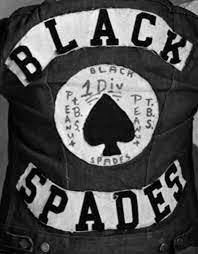
Vest of the Black Spades gang, Bronx, NYC, 1971.
Many warlords such as Bambaataa Kahim Aasim, leader of the Black Spades, wanted intergang truce. Intergang truce was accomplished in late 1971.
Peace between gang and race relations in the Bronx was necessary during the height of movement solidarity, CIA Red Scares, and post-first wave Civil Rights of the 1960s.
After the death of his cousin, Aasim was inspired by DJ artist Kool Herc to accomplish neighborhood peace through DJ parties.Like DJ Kool Herc, Aasim then continued to master his own DJ skills by creating parties in Bronx River housing projects that promoted harmony between all who lives in the Bronx.
This included mixing different beats from all walks of life: Puerto Rican, African-American, and West Indian rhythms were a priority to include in all these house parties.“Peacekeeping at parties attracting rival gangs required a soundtrack everyone can get behind: African-American, West Indian and Puerto Rican. But in practice it was musical revelation, demonstrating that genre, like racial divisions, were largely false constructs. If the rhyme was right, that’s all that mattered.”
W. Hermes. Love Goes to Buildings On Fire: Five Years In New York That Changed Music Forever. (2011) pp. 106. Volume 1
-
“Peace, Love, Unity, and Having Fun”. DJ Kool Herc on Maintaining Peaceful Gang- and Race- Relations. Part 1

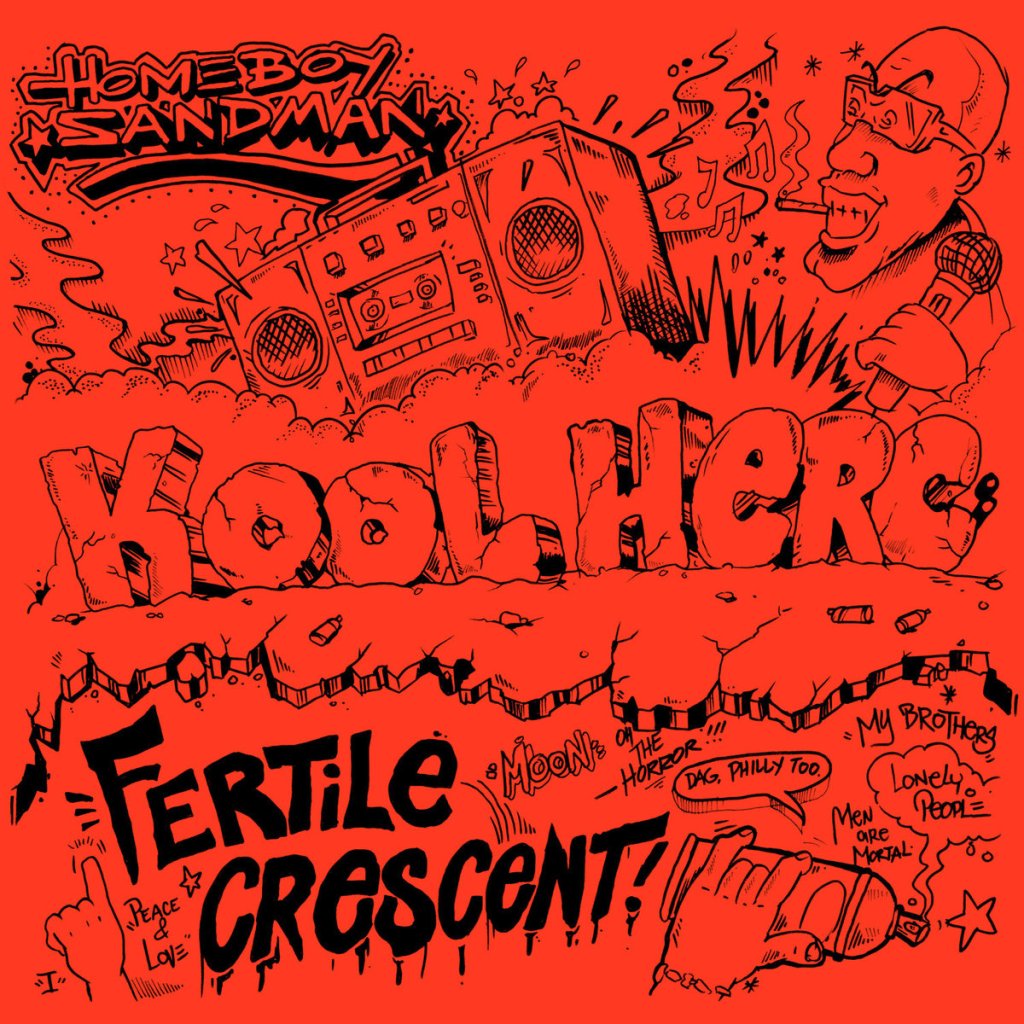
House party concert for one of DJ Kool Herc’s DJ performance. Image above, DJ Kool Herc through the times.
Hello everyone! We are back to our regular once a week post from our book Love Goes to Buildings on Fire: Five Years In New York That Changed Music Forever. This is our first reading where I reference BIPOC music history as our main source. You ever wonder how music maintained peace between gang and race relations? Check it out! Stay tuned by the end of today you’ll get a snap shot of that history featuring DJ Kool Herc.
-
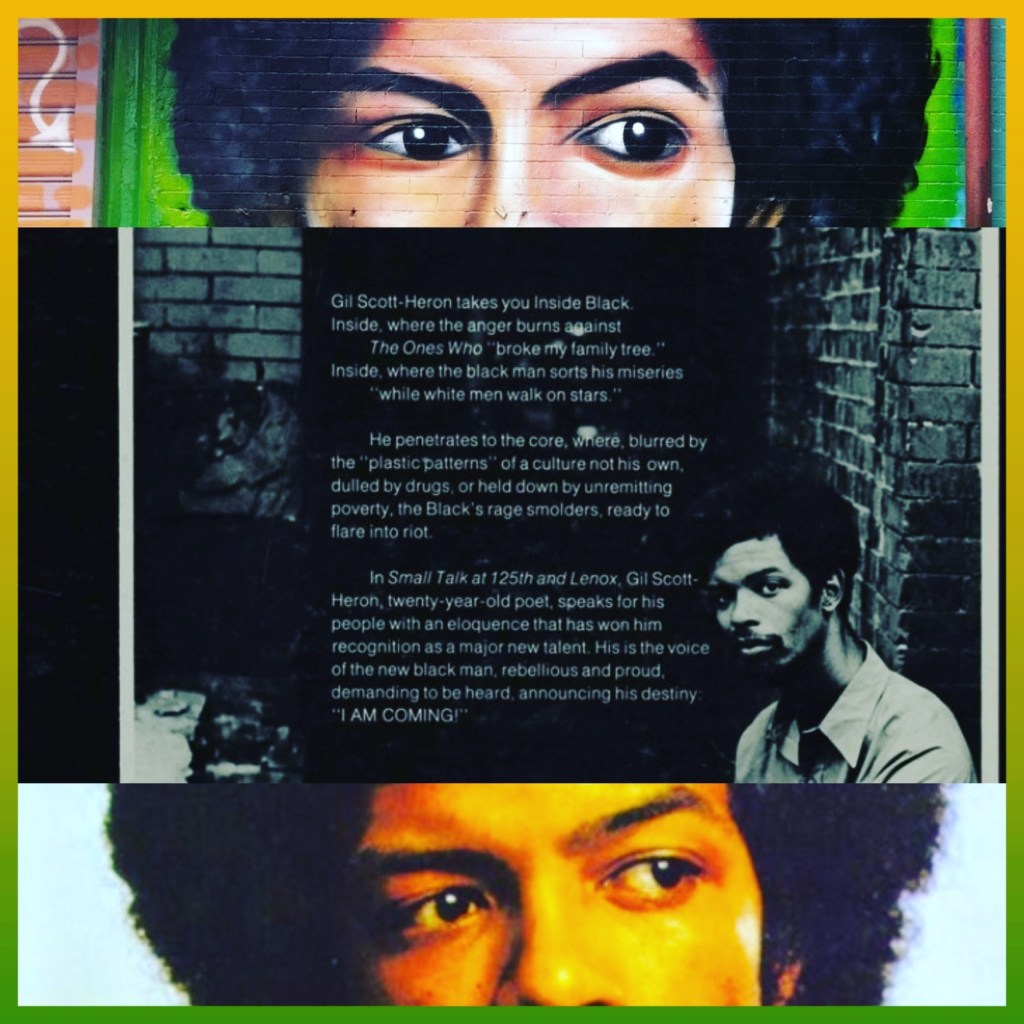
The conception of poetry music: Gil Scott-Heron 1960s – 1974
The rock and subcultural scenes of the 1960s – 1980s were all about experimenting with new blends of music. In addition to orchestral minimalism, Bob Dylan was known by the mainstream anti-war community of introducing rock music that had lyrical poetry.
However, although Dylan can be credited as being one of the iconic lyricist of his generation, he certainly wasn’t the first. According to Hermes, “the impulse to fuse poetry and music had been in the New York air for sometime – understandable in a city informed by the rhythms of jackhammers, subways, car horns, and people who won’t shut up”(pp. 58, Hermes). And to be personal, nor did it in my home city, Chicago. The environment and the culmination of socio-political strife that was the impeding result of the Civil Rights movement of the late 1950s to later 1960s.
Even with the passing of the Civil Rights Act of 1964 and deep coalitions of the Black, Red, Brown, Feminine, and Flower powers constantly organizing, there were still questions that were not vindicated. Housing, barbaric discrimination that lead to death (such as lynching that never became illegal on a national level), the moral question of integration, and reparations of the sins of the state on its minority people were still unanswered. And will be answered for a long time.
So, what better way to express those grievances publicly than with music? And express those grievances defiantly with poetry?
Over the inner city sounds and Afro-Caribbean beats, Gil Scott-Heron was creating a new sound in contemporary Jazz. His poetry in “Whitey on the Moon”(1971) and the first version of “The Revolution Televised” was complimentary to those Caribbean-Afrocentric beats of drums in the background.
Jazz was morphing into an inherently rock genre because of the the similar instruments such as a bass, guitar, drums and keyboards and moving away from an orchestral setting. Adding lyrics that spoke to the injustices of the Black community and even touching on the pathos of other oppressed communities such as the Chicano, low-rider culture of the 1960s – 1970s. “Home is Where the Hatred Is” is a perfect example of this new genre: strong bass rifts and a reliable tempo kept up by drums.
In addition to Scott-Heron being an icon to the birth of the poetry music, other poets contributed to the lyrical movement such as The Beats featuring Amiri Baraka who drew on the bebop movement of the 1950s to blend with contemporary jazz.
Overall, Gil Scott-Heron is not only the pride of the New York City music scene and one of the many beating hearts of the revolutionary machine in Chicago, his birthplace, but also another historical activist who refused to the monetization, hegemony, and surrender of the revolution. That revolution being the people, the oppressed, saying “No” to the state tyranny.
-
Minimalism and Yoko Ono 1960
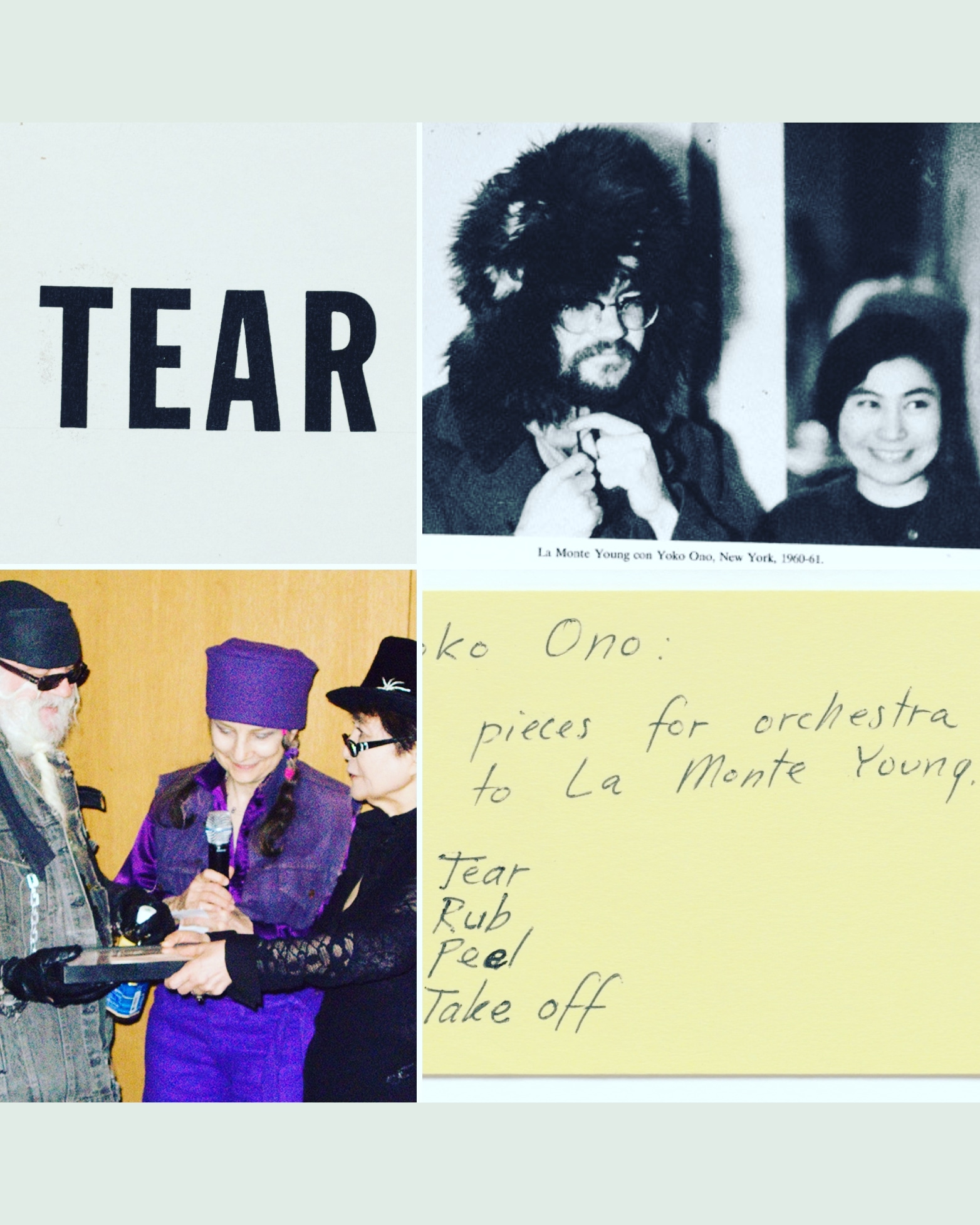
From upper left to bottom right, (1) blank background with bolded black letters titled “tear” by Yoko Ono, (2) La Monte Young and Yoko Ono in 1960 NYC, (3) La Monte Young and Yoko Ono present day, (4) poetry piece written in Yoko Ono’s handwriting “Yoko Ono, piece of the orchestra to La Monte Young: tear, rub, peel, take off. ] It was the New York school of music that performed “Four Organs” at the Carnegie Hall in 1973, New York City. This was the mainstream introduction of the minimalist movement or “static music”. This was the genre of music that introduced elongated, orchestral composers with a surrealist edge. Some popular names of the movement were Philip Glass, Terry Riley, Steve Reich, and La Monte Young to name a few.
Although La Monte Young can be rightfully credited to the conception of the minialist movement, with his inspirations from Black trumpeter Don Cherry (Ornette Coleman association), his collaboration with Yoko Ono had gave minimalism an entirely new sound and genre: “Young and Ono’s brief series changed the sound of modern composition” (pp. 45, Hermes ).
So, in 1960, Ono and Young hosted their first concert loft in her place on Chambers Street, NYC. In the fall of 1960, Young and Ono were experimenting with interactive performances. One example that Hermes gives us is a performance called “Piano Piece of David Tudor #1” while a piano is playing the audience members can bring hay and water to literally feed to the piano.. while its playing!
In addition to these performances being heavily audience based, these performances can go on for hours! Days even! These performances needed a loft setting for long hours. It was no surprise that both artist wanted secure spaces to enhance a psychedelic experience with their performances.
Both Ono and Young wanted to create an experience of bending, winding, and stretching out time with the sound of composition. Without Ono’s Fluxus art contribution, Young would discover this minimalist experiment later in the mid-60s with John Cale.
-
The 1st Latin Soulrock Fiesta, Yankee Stadium 1973
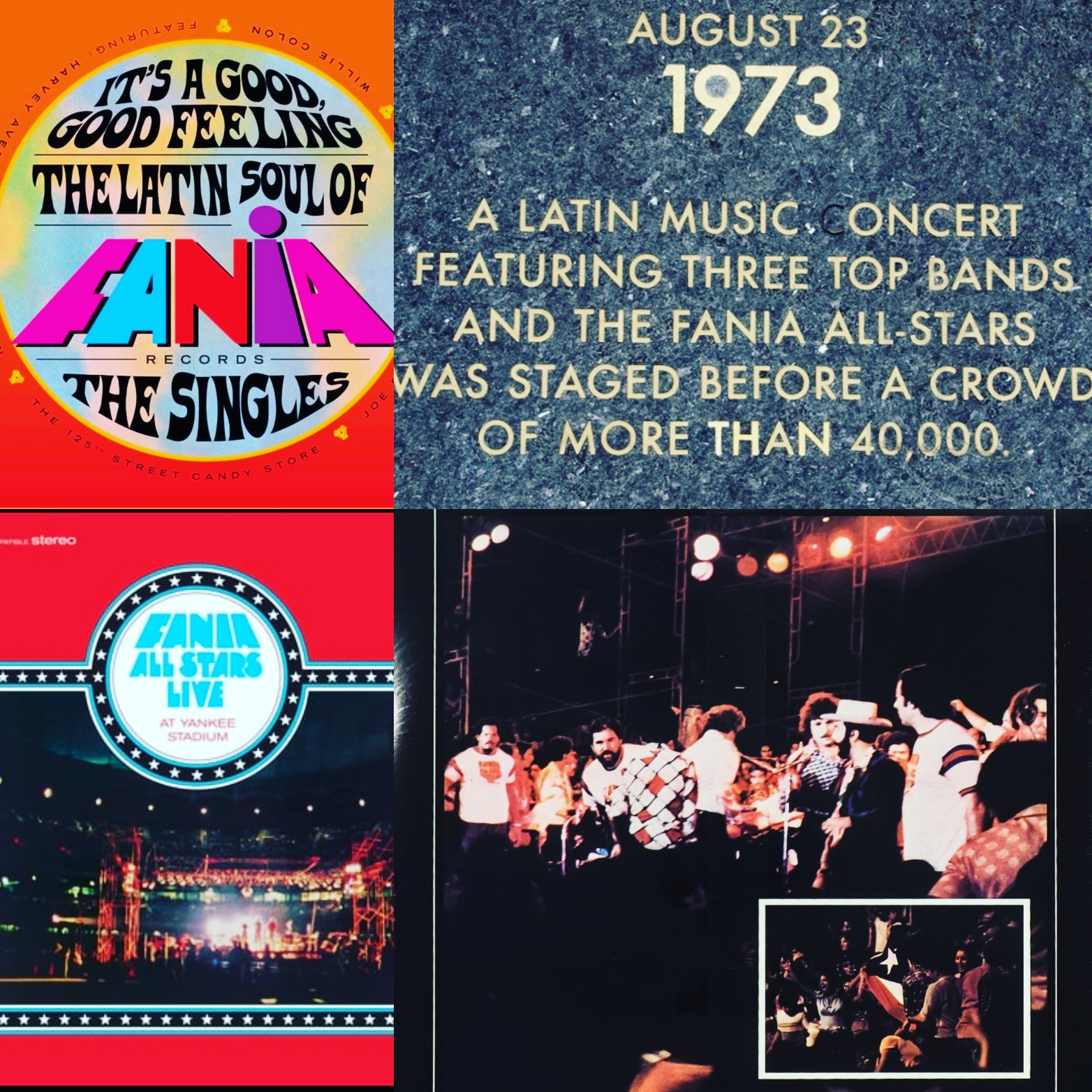
Top left to bottom right: (1) Fania All Star (2) Historical Plaque located in Ruppart Plaza Bronx, NYC (3) another album of the Yankee Stadium performance (4) photo of performance It goes by many names. Some called it the “1st Latin Soulrock Fiesta!” Others called it the “1st Fania All Stars 2nd Anniversary Concert” as that’s what it was spelled out in the ticket releases. Will Hermes appropriately also titled it “1st Latin Soulrock Jazz Fusion African Proto-Disco Fiesta!”
Regardless, the hardcore Chicanx and Afrocentric audiences of the time knew this phenomenon as the largest, well known Latin Soulrock festival performed in Yankee Stadium, New York City, 1973.
The movers and shakers of the diverse Black and Brown music liberation movement can be associated with the label record, Fania. Fania record company housed the greats: Ray Barreto, a Puerto Rican percussionist who was active in the salsa scene with his Afro-Cuban boogaloo beats. Willie Colón, who’s upbringing in the Bronx contributed to the salsa movement (which is such a surprise that today Colón gives praises to the likes of Trump and Bloomberg in spite of his progressive past). Larry Harlow, the composer of the Latin rock opera “Hommy: A Latin Opera” that featured Celia Cruz. And, the queen herself, Celia Cruz.
All of these musicians were apart of the Fania record label! And therefore all of them performed in the largest Latin performance that Friday, August 24th, 1973.
Even more multicultural performers such as Mongo Sanatamaría, Billy Cobham, Héctor Lavoe, and so many others could never imagine that their “barrio” Bronx music could make it big in an iconic stadium. It was, in a sense, their own ancestors wildest dreams that came to life in the stadium that once tried to destroy and push out Black and Brown baseball players. Such as the Afro-Latino baseball star, Roberto Clemente for his skin and heritage.
“To witness such a bicultural celebration in the baseball stadium just eight months later made the evening even more profound”.
-
Trailer for Season 1 is out!
Hi roadies! My trailer is out on Anchor and Spotify! Please check it out! https://open.spotify.com/episode/2MN10DCPvp3lRstLM0qqLx?si=ElxmagswRG6kx4HOuFnNqw&utm_source=copy-link
You can follow the count down for my release on instagram!
-
The Queen of Salsa and Her Kingdom: Celia Cruz and “Hommy, the Latin Opera” 1973
Salsa was pushing outside its own community walls in New York City, 1973 and into the elitist domain of Carnegie Hall. Simultaneously, rock operas were opening up more opportunities for musicians to be seen. And, as Hermes sums it up well, salsa “was virtuous music with deep history and an international pedigree; it wanted respect.”
So, Lawrence Ira Kahn or most known as Larry Harlow composed the Latin opera “Hommy, the Latin Opera” that would change the way Latin music was perceived in the mainstream United States.
“Hommy, a Latin Opera” was performing in Carnegie Hall. Celia Cruz, the queen of salsa, not only carried Harlow’s Latin Opera, but Cruz enabled mainstream exposure to other musicians such as Barretto and Mongo Santamaria performing along side Cruz.
In spite of Celia Cruz being in political exile from Cuba since 1962 and being Afro-Cuban during post-Civil Rights United States, Cruz is the pride of Latinx music and salsa.

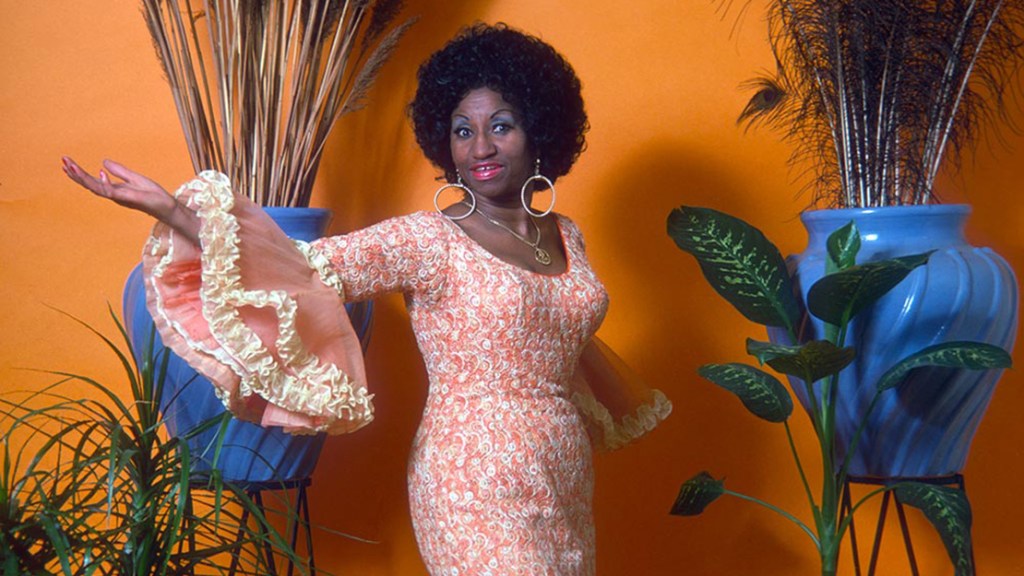

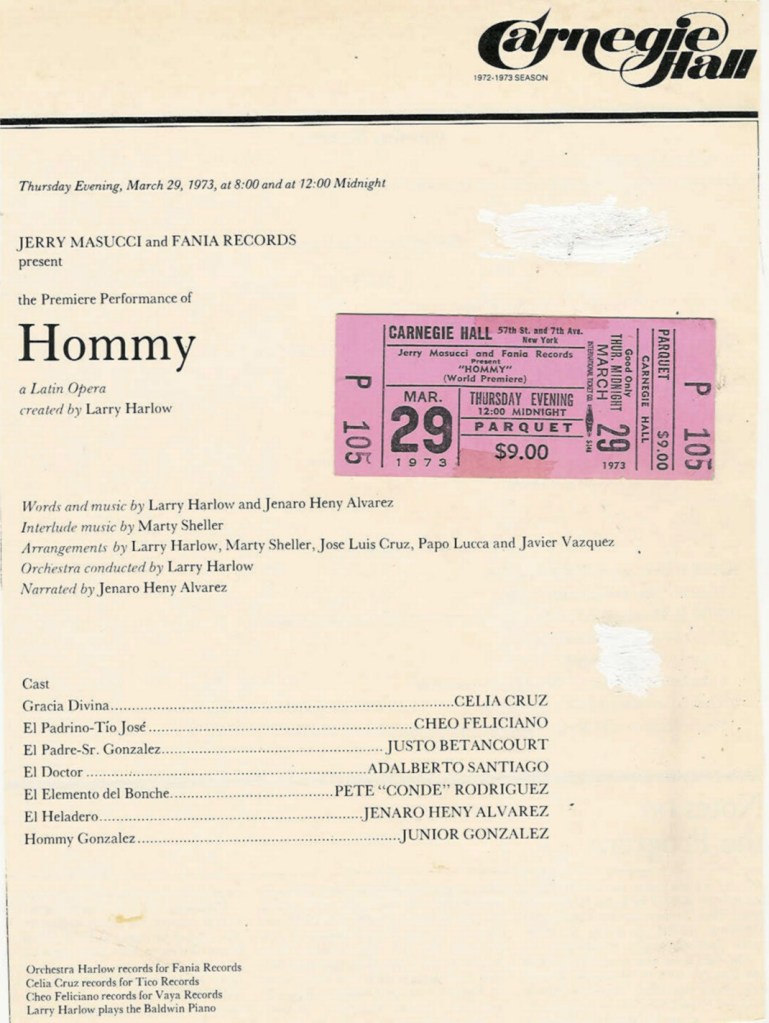
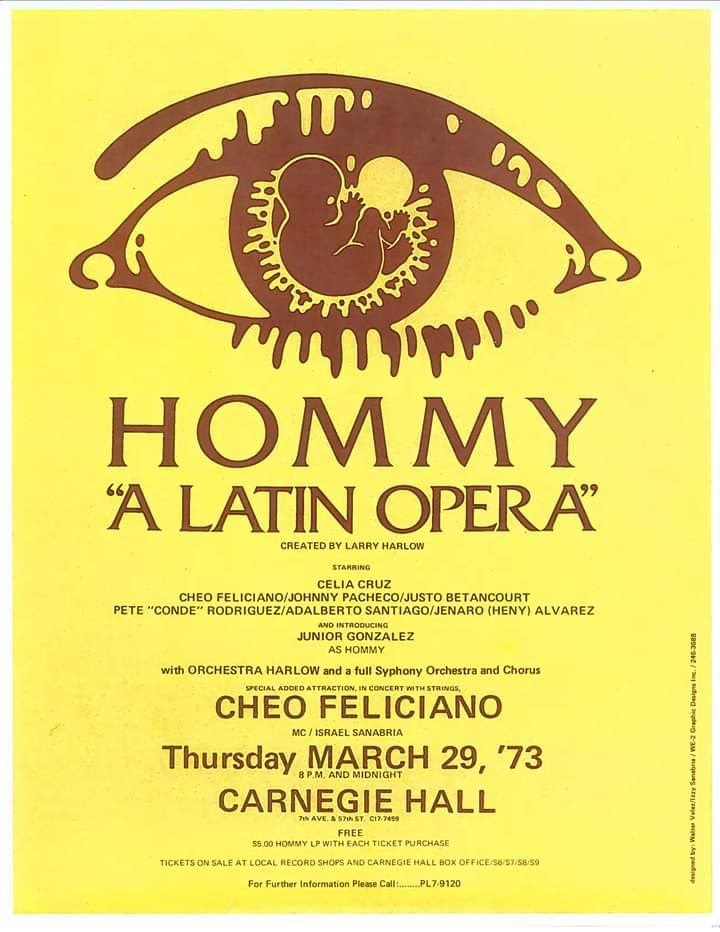
From top left to bottom right: (1) Larry Harlow in front of his advistisment for the Latin Opera (2) Celia Cruz (3) 1973 News article on the Latin opera (4) Ticket and program for Carnegie Hall (5) Program cover for the opera Source: Hermes, W (2014)., Love Goes to Buildings on Fire: Five Years In New York That Changed Music Forever. pp. 25.
-
Reading #1: “Love Goes to Buildings on Fire: Five Years In New York That Changed Music Forever” – Will Hermes
Happy Monday roadies! While we wait for January 8th for my first episode with @chickenhappen , I will be posting fun historical facts about inclusive music history based on the current book I am reading.
For this month, our book is “Love Goes To Buildings On Fire: Five Years In New York That Changed Music Forever” by Will Hermes. We are taken on a journey of the genre explosion of punk, salsa, hip-hop, and rock changed the music landscape forever after the mid 70s. I’m enjoying it so far!
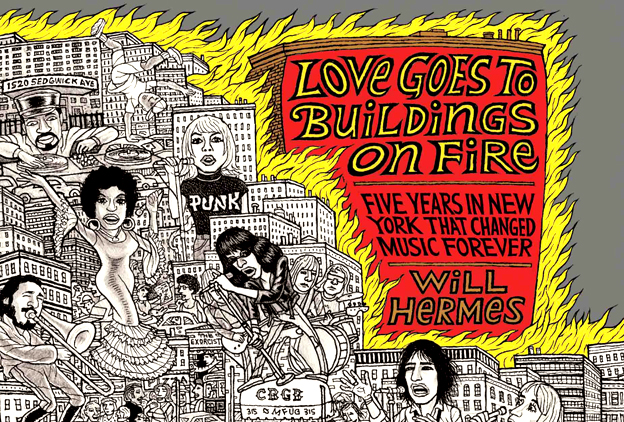
Photograph by Ken Regan/Camera 5, excerpted from ‘Love Goes to Buildings On Fire.’
-
Subscribe
Subscribed
Already have a WordPress.com account? Log in now.
 Loose Lips Cast