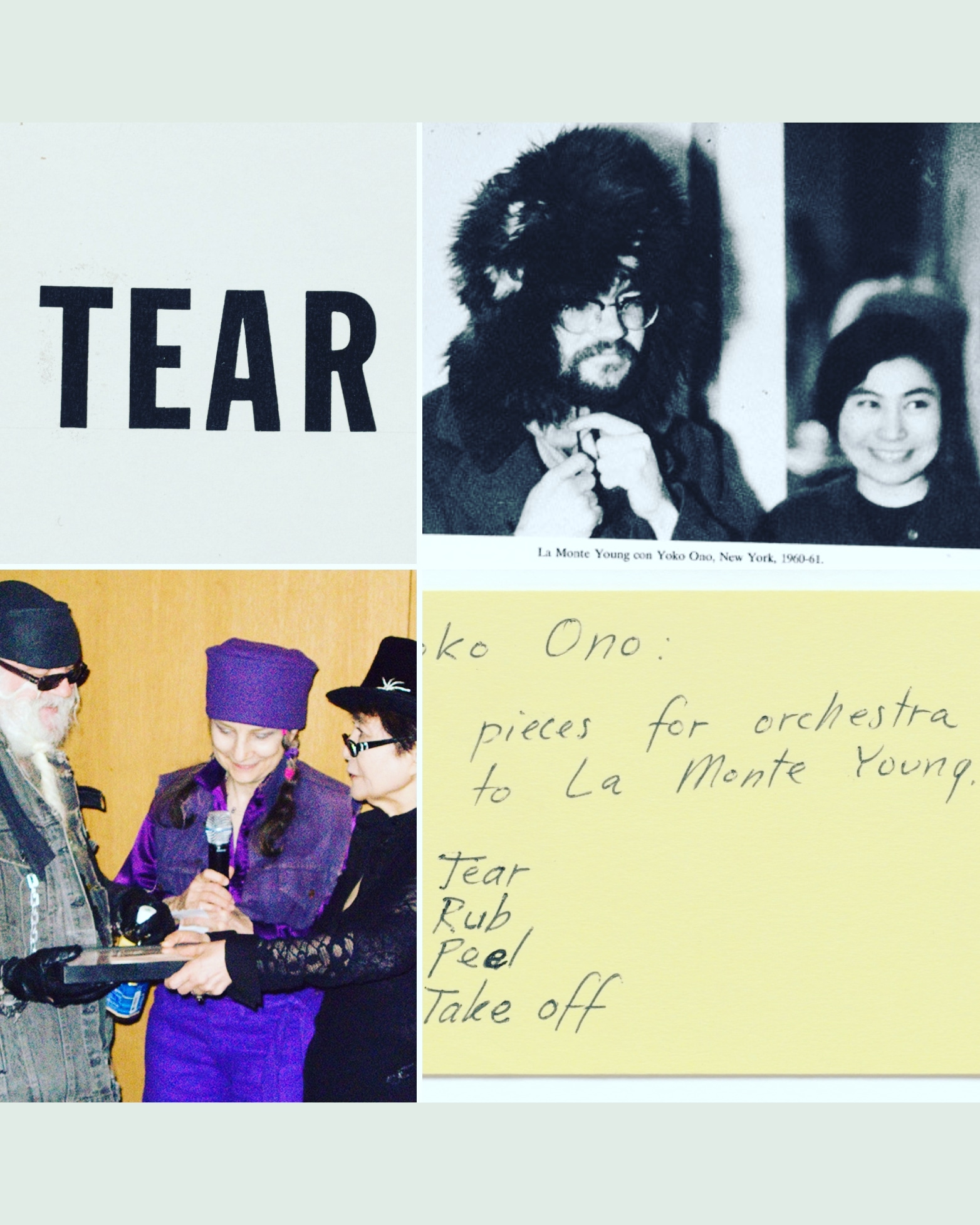
It was the New York school of music that performed “Four Organs” at the Carnegie Hall in 1973, New York City. This was the mainstream introduction of the minimalist movement or “static music”. This was the genre of music that introduced elongated, orchestral composers with a surrealist edge. Some popular names of the movement were Philip Glass, Terry Riley, Steve Reich, and La Monte Young to name a few.
Although La Monte Young can be rightfully credited to the conception of the minialist movement, with his inspirations from Black trumpeter Don Cherry (Ornette Coleman association), his collaboration with Yoko Ono had gave minimalism an entirely new sound and genre: “Young and Ono’s brief series changed the sound of modern composition” (pp. 45, Hermes ).
So, in 1960, Ono and Young hosted their first concert loft in her place on Chambers Street, NYC. In the fall of 1960, Young and Ono were experimenting with interactive performances. One example that Hermes gives us is a performance called “Piano Piece of David Tudor #1” while a piano is playing the audience members can bring hay and water to literally feed to the piano.. while its playing!
In addition to these performances being heavily audience based, these performances can go on for hours! Days even! These performances needed a loft setting for long hours. It was no surprise that both artist wanted secure spaces to enhance a psychedelic experience with their performances.
Both Ono and Young wanted to create an experience of bending, winding, and stretching out time with the sound of composition. Without Ono’s Fluxus art contribution, Young would discover this minimalist experiment later in the mid-60s with John Cale.
 Loose Lips Cast
Leave a comment